01
Transaction-only blind spots
Transaction and application events can leave device-level and behavioral threat surfaces outside the decision context.
Extend fraud visibility beyond transactions. VMATIC Shield correlates device, application, behavioral and contextual signals to help banks detect emerging fraud, evaluate risk and act before customer harm occurs.
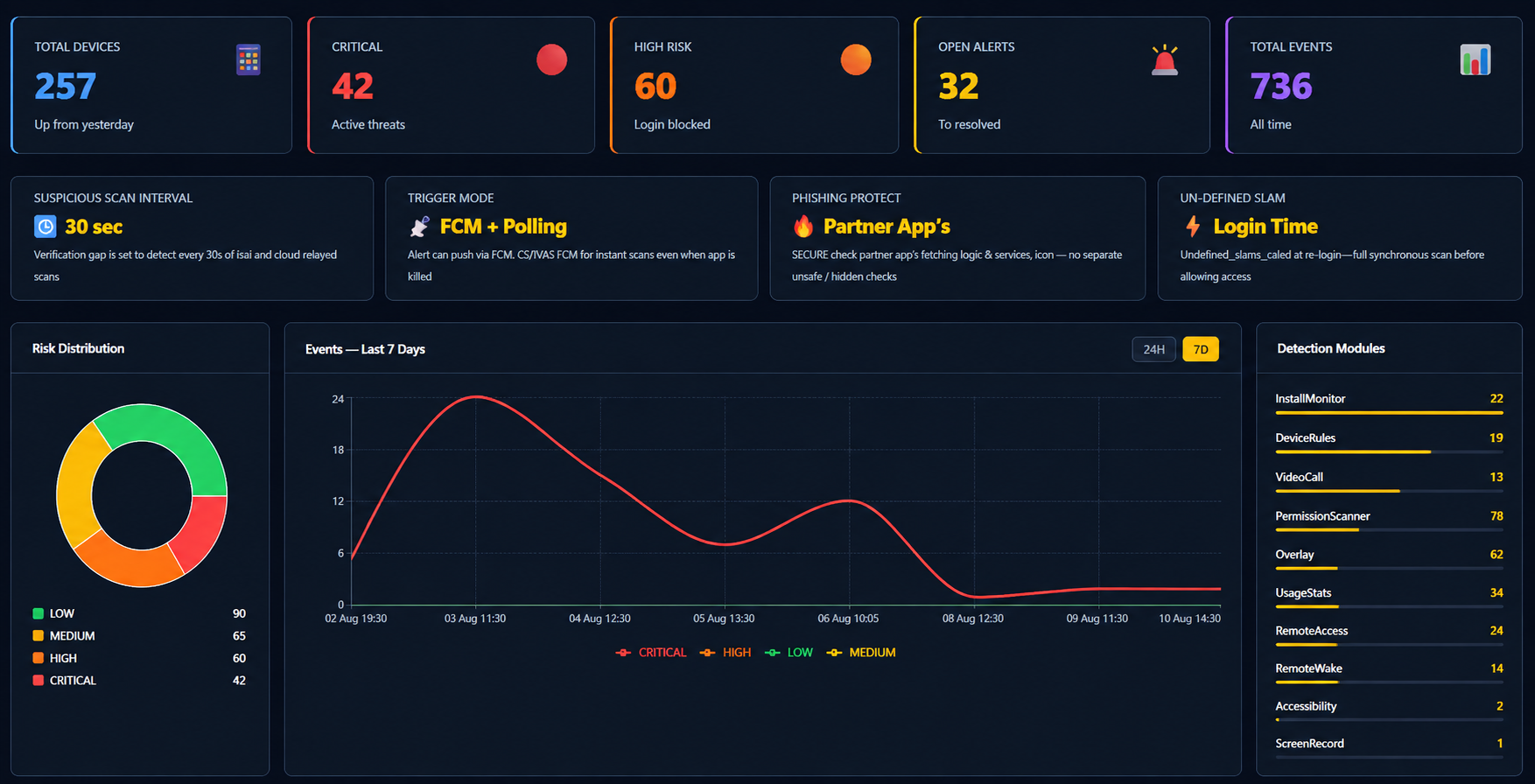
VMATIC Shield is designed to surface risk signals that can exist below, around and before a financial transaction.
Transaction and application events can leave device-level and behavioral threat surfaces outside the decision context.
Malware, remote access, digital arrest and social-engineering indicators can emerge before a transaction is initiated.
Bring device integrity, application trust, permissions and contextual signals into fraud decisioning.
Event-driven evaluation helps reduce the window between a risk event and the bank's response.
Shield combines device intelligence and fraud operations so banks can move from isolated events to contextual, actionable risk.
VMATIC's framework combines proprietary detection models and configurable risk policies, allowing financial institutions to customize response strategies around their own risk appetite.
Device security posture, integrity status and trust indicators.
Installer source, authenticity, privilege and execution risk.
Detect indicators associated with impersonation, coercive communications and customer manipulation.
Device-control scenarios and suspicious remote interaction patterns.
Deviation analysis and suspicious device activity.
Elevated permissions and abnormal privilege-related risk indicators.
Connects independent indicators to reveal complex scenarios.
Continuously evaluates customer, device, application and behavior intelligence.
Organization-specific fraud responses without application redevelopment.
Configurable thresholds, actions and adaptive controls.
Contextual alerts for customers, fraud teams and enterprise monitoring.
Trust profiles built from historical activity and accumulated risk intelligence.
Extensible repository for new techniques, attack vectors and patterns.
Correlated evidence, event timelines and case support.
Live fraud trends, risk posture, alert volumes and effectiveness.
CBS, fraud management, payment, notification and security infrastructure.
Audit logging, policy versioning, reporting and governance controls.
Modular introduction of new use cases, rule packs and enhancements.
Ongoing incorporation of emerging fraud scenarios and behavioral models.
Keep fraud strategy, thresholds and workflows under bank control.
Digital Arrest and remote-access fraud are behavior-driven threats. Shield is designed to evaluate the surrounding device and session context before a transaction is executed.
Identify prolonged video-call patterns, remote assistance indicators and suspicious device behavior associated with digital-arrest schemes.
Detect applications and device-control scenarios commonly involved in fraud incidents and incorporate them into transaction risk.
Use application trust, installer provenance and behavioral analysis to identify suspicious or novel application risk beyond signature-only matching.
Combine device and behavioral indicators with transaction context so fraud teams can intervene while the customer journey is still in progress.
Shield's scoring methodology correlates application trust, behavioral indicators, device integrity and contextual intelligence. Banks can define thresholds and workflows around their own risk posture.
Bring live alerts, digital-arrest incidents, high-risk customers, blocked transactions, remote-access events and risk analytics into a unified operational view.
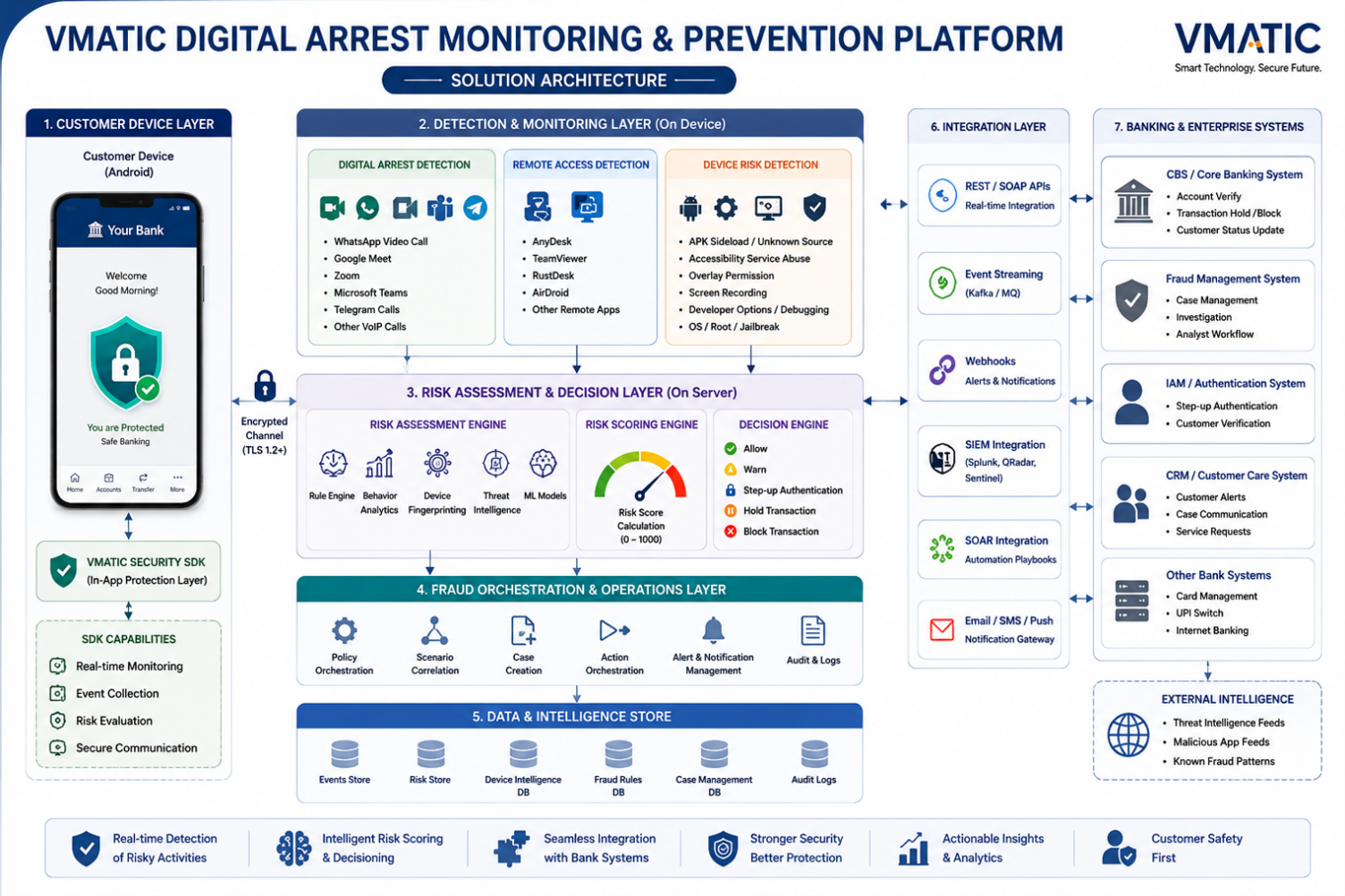
Designed for minimum-data fraud intelligence and bank-controlled deployment.
VMATIC Shield is positioned as an additive intelligence layer—not a rip-and-replace core. Secure APIs can feed existing fraud engines, CBS, SIEM and SOC workflows.
This benchmark is intentionally capability-based. It avoids claiming that another vendor cannot support a feature unless the comparison is explicitly documented.
| Capability | Traditional AV / Mobile Security | Transaction-only Fraud Controls | VMATIC Shield |
|---|---|---|---|
| Malware / application security signals | ✓ | Limited | ✓ Integrates |
| Device security monitoring | ✓ | Partial | ✓ Risk-focused |
| Digital Arrest detection | — | — | ✓ |
| Video-call / coercion context | — | — | ✓ |
| Remote-access fraud detection | Limited | Partial | ✓ |
| Multi-signal device + behavior correlation | Partial | ✓ Transaction signals | ✓ |
| Dynamic risk scoring | Partial | ✓ | ✓ |
| Bank-defined rules / workflows | Partial | ✓ | ✓ |
| Transaction hold / block decision support | — | ✓ | ✓ |
| Fraud operations dashboard | Limited | ✓ | ✓ |
| Case / investigation intelligence | — | Varies | ✓ |
| Bank-owned deployment / policy control | Varies | Varies | ✓ Designed for bank control |
VMATIC Shield is a bank-owned fraud prevention operations platform that extends fraud visibility beyond transactions into device, application, behavioral and contextual intelligence.
Shield is designed as an additive intelligence layer. Risk intelligence can be delivered through APIs to existing fraud rule engines, CBS, SIEM and SOC workflows without requiring a rip-and-replace approach.
Yes. The supplied VMATIC solution design includes detection of prolonged video-call patterns, remote assistance indicators and suspicious device behavior associated with Digital Arrest scenarios.
The platform material states that it does not access financial credentials, passwords, PINs or account balances.
The VMATIC material describes server-managed rule frameworks and bank-owned policy control so new fraud typologies can be addressed through rule updates rather than an SDK release cycle.
The documented integration architecture includes Core Banking Systems, mobile and internet banking, fraud monitoring systems, SMS, push notification and email gateways, plus secure API integration with SIEM/SOC workflows.
Bring your current fraud stack, device-security controls and high-risk use cases. Evaluate where VMATIC Shield can add earlier signals, stronger context and bank-controlled response.